 DataPatrons
Case — Cloudwright
Migrating AWS serverless architectures to GCP — with a plan, not a prompt
Most AI-assisted migration tools take a shortcut: point an LLM at your infrastructure and let it generate code in one shot. Cloudwright is built the opposite way — a deterministic, phase-gated pipeline where AI proposes and a human approves, every step leaves an inspectable record, and nothing gets transformed until the migration plan is signed off.
- Type
- Applied AI engineering — internal R&D
- Status
- V1 — Python Lambda migrations complete
- Core stack
- Python 3.12, Typer, Pydantic v2, SQLite
- AI providers
- Vertex AI, Anthropic, OpenAI
The problem
Teams migrating AWS serverless workloads to GCP are usually stuck between two bad options. Manual migration is slow and demands deep, current expertise in both clouds. One-shot LLM code generation is fast but unaccountable — no audit trail, no checkpoint before it touches infrastructure, and no way to trust the output without re-reading all of it yourself. Neither is something you'd put in front of a client's production AWS account.
The approach
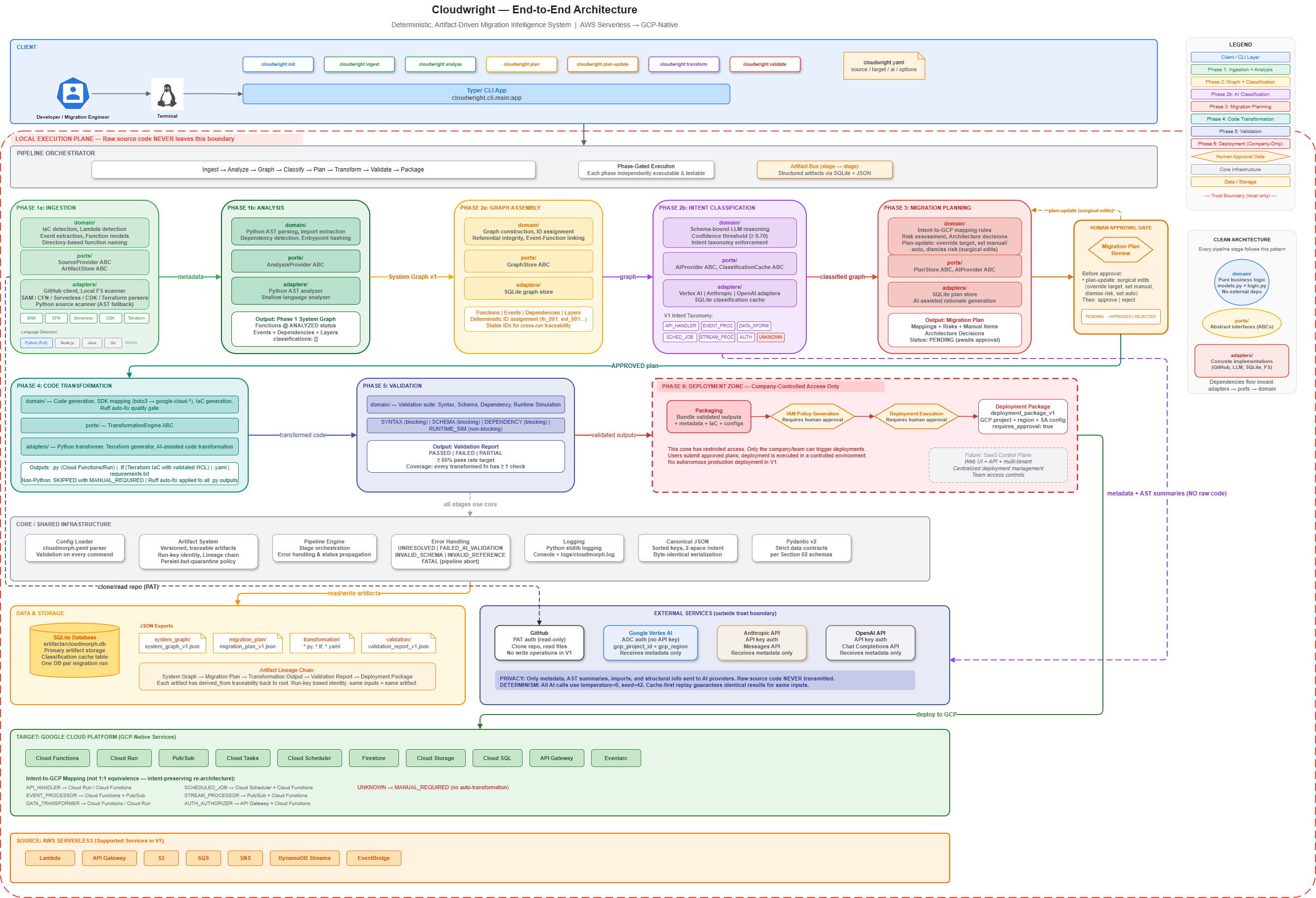
Cloudwright runs the migration as a phase-gated pipeline. Every stage reads and writes versioned artifacts through a shared SQLite artifact bus — nothing is passed between stages as an in-memory side effect, so every intermediate decision is inspectable and reproducible.
The Plan stage is the gate: Cloudwright will not transform a single file until a human has reviewed and approved the migration plan it proposes. AI involvement is deliberately narrow and controlled — every LLM call is schema-validated against a strict output contract, temperature-locked, and cached by input hash so the same input never silently produces a different plan on a second run.
Design principles
What it does today
V1 performs full, automated transformations for Python Lambda functions — detecting the deployed IaC format (SAM, CloudFormation, Serverless Framework, CDK, or Terraform), analyzing the workload, and producing a human-approved, intent-preserving GCP-native migration. It also detects, models, and plans migrations for Node.js, Java, and Go workloads, ahead of full transform support for those runtimes.
- Clean Architecture throughout — domain logic never touches adapter/SDK types directly
- Strict mypy, Ruff linting, and a pytest suite with coverage tracking
- Multi-provider AI — Vertex AI (via ADC, no API key required), Anthropic, or OpenAI
- Fully containerized (Docker), zero-dependency storage layer (SQLite, stdlib)
Full architecture reference
The diagram below is the real end-to-end architecture drawing — every zone, trust boundary, and approval gate as built, not a simplified marketing version.
Watch it run
Have a similar migration or AI-agent problem?
Whether it's a cloud migration, an internal agent, or something that needs the same discipline — plan first, execute with checkpoints — we'd like to hear about it.
Let's discuss it →Read more about how we approach this work — GCP Cloud Architecture & Migration →